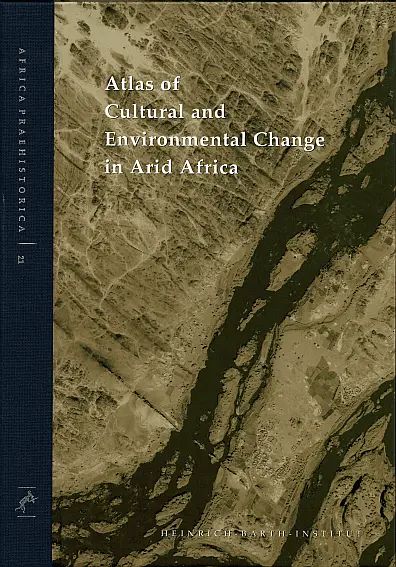
Atlas of Cultural and Environmental Change in Arid Africa

Herausgeber/in:
Editor:
Olaf Bubenzer, Andreas Bolten & Frank Darius
Erscheinungsjahr:
Publication year:
2007
Reihe & Band:
Series & Number:
Africa Praehistorica 21
ISBN:
ISBN:
978-3-927688-32-2
DOI:
DOI:
10.18716/hbi/ap21
PDF:
PDF:
Open access
Buch:
Book:
45 €
45 €
Dieses Buch ist ausverkauft This book is out of stock

Über diese Publikation:

Der Atlas umfasst 59 Beiträge zu Fallstudien des Kölner Sonderforschungsbereichs "Arides Klima, Adaptation und kulturelle Innovation in Afrika" (ACACIA, Sonderforschungsbereich 389). Sie sind bewusst kurz gehalten, decken Regionen unterschiedlicher Größe ab und haben eine unterschiedliche zeitliche Tiefe. Aus diesem Grund können sie natürlich nicht alle Ergebnisse eines groß angelegten Projekts widerspiegeln, das seit mehr als zwölf Jahren läuft. Dennoch zeigt der Atlas einen soliden und repräsentativen Querschnitt, da Beteiligte aller Teilprojekte vertreten sind. Die Fallstudien sind thematisch in fünf Hauptkapitel gegliedert. Die ersten beiden Kapitel gehen Fragen nach den Wechselbeziehungen zwischen dem Menschen und seiner "physischen Umwelt" während der letzten 12.000 Jahre in den untersuchten Regionen in Nordost- und Südwestafrika nach. Die Stichworte "Paläoumwelt" und "Landschaftsnutzung" umreißen grob die hier behandelten Themen. Die folgenden drei Kapitel befassen sich mit weiteren ACACIA-Schwerpunkten: der Überbrückung von Trockengebieten, der Sprachgeschichte sowie dem wirtschaftlichen und demographischen Wandel. Der abschließende Abschnitt mit Satellitenbildern gibt einen Überblick über die Standorte aller Beiträge und deren räumlichen Bezug.

About this publication:

The atlas is composed of 59 contributions about case studies of the Cologne collaborative research centre 'Arid Climate, Adaptation and Cultural Innovation in Africa' (ACACIA, Sonderforschungsbereich 389). Consciously held short, they cover regions of diverging size and have different depths in time. For this reason, they obviously cannot reflect all the results of a large-scale project which has been running for more than twelve years. Nonetheless, the atlas shows a sound and representative cross section since contributors of all sub-projects are represented. The case studies are structured according to theme in five main chapters. The first two chapters pursue questions regarding the inter-relations between humans and their 'physical environment' during the last 12,000 years in the regions studied in northeast and southwest Africa. The keywords 'palaeoenvironment' and 'landscape usage' roughly outline the topics discussed here. The following three chapters deal with further ACACIA focal points: the bridging of arid regions, language history as well as economic and demographic change. The final section of satellite images gives an overview of all the contributions' locations and their spatial relation.


Inhalt:

  • Environmental change and cultural history in northeastern and southwestern Africa — Rudolph Kuper, Wilhelm Möhlig, Michael Bollig & Olaf Bubenzer
  • ACACIA – central administration and coordination — Werner Schuck

Reconstructing environment and human occupation

  • From hyperarid to semiarid – actual climatic conditions in northeastern and southwestern Africa — Olaf Bubenzer & Mathias Ritter
  • From space to earth – use of satellite data in ACACIA — Andreas Bolten
  • Watershed analysis in the Western Desert of Egypt — Andreas Bolten & Olaf Bubenzer
  • 'Looking behind the scenes' – archaeological distribution patterns and their meaning — Rudolph Kuper
  • Djara – humans and their environment on the Egyptian limestone plateau around 8,000 years ago — Karin Kindermann & Olaf Bubenzer
  • Mapping the movement of pastro-foragers: the spread of Desert Glass and other objects in the eastern Sahara during the Holocene 'humid phase' — Heiko Riemer
  • Rocky islands within oceans of sand – archaeology of the Jebel Ouenat / Gilf Kebir region, eastern Sahara — Jörg Linstädter
  • The Wadi Howar — Stefan Kröpelin
  • The flora and vegetation of Wadi Howar — Stefanie Nussbaum, Stefan Kröpelin & Frank Darius
  • Holocene settlement dynamics in the Wadi Howar region (Sudan) and the Ennedi Mountains (Chad) — Friederike Jesse & Birgit Keding
  • Transformations of settlement patterns in the Middle Wadi Howar during the Holocene — Birgit Keding & Ursula Eisenhauer
  • Cattle herding in the southern Libyan Desert — Friederike Jesse, Birgit Keding, Nadja Pöllath, Marianne Bechhaus-Gerst & Tilman Lenssen-Erz
  • Ennedi Highlands, Chad – artists and herders in a lifeworld on the margins — Tilman Lenssen-Erz
  • The Saharan lakes of Ounianga Serir – a unique hydrological system — Stefan Kröpelin
  • High-resolution climate archives in the Sahara (Ounianga, Chad) — Stefan Kröpelin
  • Reconnaissance of the Erdi Ma (northeast Chad) — Stefan Kröpelin
  • Dunes and megadunes in the southern Namib Erg and the southern Great Sand Sea – a transcontinental comparison — Helga Besler, Oliver Bödeker & Olaf Bubenzer
  • Holocene climatic change, human adaptation and landscape degradation in arid Africa as evidenced by the faunal record — Nadja Pöllath & Joris Peters
  • Changing settlement patterns in Namibia during the Holocene — Ralf Vogelsang & Karl Peter Wendt
  • Brandberg/Daureb, Namibia – painters of a prehistoric hunter-gatherer world — Tilman Lenssen-Erz

Landscape and land use

  • Climate, relief, bedrock and substrate – main factors for the soil formation in arid regions — Olaf Bubenzer & Andreas Bolten
  • In search of the bloom – plants as witnesses to the humid past — Frank Darius & Stefanie Nussbaum
  • Vegetation mapping for the evaluation of traditional land use and conservation activities in the northern Richtersveld, Namaqualand (South Africa) — Stefanie Nussbaum & Frank Darius
  • Biomass production and seasonal ecologic behaviour based on a remote sensing modelling approach — Jochen Richters
  • Geomorphological-climatological interactions in the Dakhla Oasis (Western Desert of Egypt) — Mathias Ritter
  • Spectral analysis of remote sensing data for geomorphological, geological and geoecological research in arid Africa — Guido Waldhoff
  • High resolution satellite images and Differential GPS in geomorphological and geoarchaeological research on Boni Island (Fourth Nile Cataract, north Sudan) — Mathias Ritter & Tobias Diehl
  • Landscape and logistics – the success of Ancient Egypt — Michael Herb
  • Inequalities inscribed in landscape — Michael Schnegg & Torsten Welle
  • Space matters – sustainable range management in a highly variable environment — Anja Linstädter & Andreas Bolten
  • Natural resource management in a conservancy in northern Namibia — Bettina Zieß
  • Adaptation strategies on a local scale in the context of Global Change? — Torsten Welle
  • Mapping culture, representing boundaries and politicising difference – reflections on two San cases in Namibia — Gertrud Boden
  • Poetry, landscape and the spatialisation of collective memory in Otjiherero praise poems — Laura E. Bleckmann
  • Desert parks in the eastern Sahara — Rudolph Kuper
  • Wadi Howar National Park — Stefan Kröpelin & Sven Oehm
  • 100 years of Etosha – an issue of people and parks — Ute Dieckmann

Routes and trade

  • The Abu Ballas Trail: a Pharaonic donkey-caravan route in the Libyan Desert (SW-Egypt) — Frank Förster
  • The archaeology of a desert road – the navigation system of the Abu Ballas Trail — Heiko Riemer
  • Caravan routes – discovered with satellite eyes — Jan Skriwanek
  • Mobile oases in the Libyan Desert — Meike Meerpohl
  • The long journey – aspects of labour migration in Kunene South — Clemens Greiner

Language and space

  • Namibian languages — Wilhelm Möhlig & Frank Seidel
  • The Wadi Howar diaspora – linking linguistic diffusion to palaeoclimatological and archaeological findings — Gerrit Dimmendaal
  • Northern Namibia – overview of its historiography based on linguistic and extralinguistic evidence — Frank Seidel, Eileen Kose & Wilhelm Möhlig
  • Folktales as a source of investigation of cultural diffusion in Namibia and southern Angola — Marc Seifert
  • 'Astronomy of the For' – orientation in time and space — Christine Waag

Economic and demographic change

  • The European agricultural appropriation of the Outjo district in northern central Namibia — Ute Dieckmann
  • Economic trends and coping strategies in the history of European farming in northern central Namibia — Ute Dieckmann
  • Boreholes – the dynamics of pastoralism in northwestern Namibia — Michael Bollig
  • 'Going to greet the relatives' – household economy, mobility and politics in Dar Zaghawa, NE-Chad — Grit Jungstand
  • Settlement patterns in a risky environment – Tama villages in northeastern Chad — Babett Janszky
  • 'We can count on us' – the stability of households in the Richtersveld, South Africa — Susanne Berzborn
  • Gendered space – female headed households in Fransfontein, northwest Namibia — Julia Pauli
  • How history crosses the threshold of the domestic sphere – persistence and change within Khwe residential units in West Caprivi — Gertrud Boden
  • Sharing space and food in Namibia — Michael Schnegg & Andreas Bolten
  • Inheritance and maintenance among the Himba of the Kunene region — Michael Bollig
  • Bibliography
  • Satellite-image maps
  • List of abbreviations


Contents:

  • Environmental change and cultural history in northeastern and southwestern Africa — Rudolph Kuper, Wilhelm Möhlig, Michael Bollig & Olaf Bubenzer
  • ACACIA – central administration and coordination — Werner Schuck

Reconstructing environment and human occupation

  • From hyperarid to semiarid – actual climatic conditions in northeastern and southwestern Africa — Olaf Bubenzer & Mathias Ritter
  • From space to earth – use of satellite data in ACACIA — Andreas Bolten
  • Watershed analysis in the Western Desert of Egypt — Andreas Bolten & Olaf Bubenzer
  • 'Looking behind the scenes' – archaeological distribution patterns and their meaning — Rudolph Kuper
  • Djara – humans and their environment on the Egyptian limestone plateau around 8,000 years ago — Karin Kindermann & Olaf Bubenzer
  • Mapping the movement of pastro-foragers: the spread of Desert Glass and other objects in the eastern Sahara during the Holocene 'humid phase' — Heiko Riemer
  • Rocky islands within oceans of sand – archaeology of the Jebel Ouenat / Gilf Kebir region, eastern Sahara — Jörg Linstädter
  • The Wadi Howar — Stefan Kröpelin
  • The flora and vegetation of Wadi Howar — Stefanie Nussbaum, Stefan Kröpelin & Frank Darius
  • Holocene settlement dynamics in the Wadi Howar region (Sudan) and the Ennedi Mountains (Chad) — Friederike Jesse & Birgit Keding
  • Transformations of settlement patterns in the Middle Wadi Howar during the Holocene — Birgit Keding & Ursula Eisenhauer
  • Cattle herding in the southern Libyan Desert — Friederike Jesse, Birgit Keding, Nadja Pöllath, Marianne Bechhaus-Gerst & Tilman Lenssen-Erz
  • Ennedi Highlands, Chad – artists and herders in a lifeworld on the margins — Tilman Lenssen-Erz
  • The Saharan lakes of Ounianga Serir – a unique hydrological system — Stefan Kröpelin
  • High-resolution climate archives in the Sahara (Ounianga, Chad) — Stefan Kröpelin
  • Reconnaissance of the Erdi Ma (northeast Chad) — Stefan Kröpelin
  • Dunes and megadunes in the southern Namib Erg and the southern Great Sand Sea – a transcontinental comparison — Helga Besler, Oliver Bödeker & Olaf Bubenzer
  • Holocene climatic change, human adaptation and landscape degradation in arid Africa as evidenced by the faunal record — Nadja Pöllath & Joris Peters
  • Changing settlement patterns in Namibia during the Holocene — Ralf Vogelsang & Karl Peter Wendt
  • Brandberg/Daureb, Namibia – painters of a prehistoric hunter-gatherer world — Tilman Lenssen-Erz

Landscape and land use

  • Climate, relief, bedrock and substrate – main factors for the soil formation in arid regions — Olaf Bubenzer & Andreas Bolten
  • In search of the bloom – plants as witnesses to the humid past — Frank Darius & Stefanie Nussbaum
  • Vegetation mapping for the evaluation of traditional land use and conservation activities in the northern Richtersveld, Namaqualand (South Africa) — Stefanie Nussbaum & Frank Darius
  • Biomass production and seasonal ecologic behaviour based on a remote sensing modelling approach — Jochen Richters
  • Geomorphological-climatological interactions in the Dakhla Oasis (Western Desert of Egypt) — Mathias Ritter
  • Spectral analysis of remote sensing data for geomorphological, geological and geoecological research in arid Africa — Guido Waldhoff
  • High resolution satellite images and Differential GPS in geomorphological and geoarchaeological research on Boni Island (Fourth Nile Cataract, north Sudan) — Mathias Ritter & Tobias Diehl
  • Landscape and logistics – the success of Ancient Egypt — Michael Herb
  • Inequalities inscribed in landscape — Michael Schnegg & Torsten Welle
  • Space matters – sustainable range management in a highly variable environment — Anja Linstädter & Andreas Bolten
  • Natural resource management in a conservancy in northern Namibia — Bettina Zieß
  • Adaptation strategies on a local scale in the context of Global Change? — Torsten Welle
  • Mapping culture, representing boundaries and politicising difference – reflections on two San cases in Namibia — Gertrud Boden
  • Poetry, landscape and the spatialisation of collective memory in Otjiherero praise poems — Laura E. Bleckmann
  • Desert parks in the eastern Sahara — Rudolph Kuper
  • Wadi Howar National Park — Stefan Kröpelin & Sven Oehm
  • 100 years of Etosha – an issue of people and parks — Ute Dieckmann

Routes and trade

  • The Abu Ballas Trail: a Pharaonic donkey-caravan route in the Libyan Desert (SW-Egypt) — Frank Förster
  • The archaeology of a desert road – the navigation system of the Abu Ballas Trail — Heiko Riemer
  • Caravan routes – discovered with satellite eyes — Jan Skriwanek
  • Mobile oases in the Libyan Desert — Meike Meerpohl
  • The long journey – aspects of labour migration in Kunene South — Clemens Greiner

Language and space

  • Namibian languages — Wilhelm Möhlig & Frank Seidel
  • The Wadi Howar diaspora – linking linguistic diffusion to palaeoclimatological and archaeological findings — Gerrit Dimmendaal
  • Northern Namibia – overview of its historiography based on linguistic and extralinguistic evidence — Frank Seidel, Eileen Kose & Wilhelm Möhlig
  • Folktales as a source of investigation of cultural diffusion in Namibia and southern Angola — Marc Seifert
  • 'Astronomy of the For' – orientation in time and space — Christine Waag

Economic and demographic change

  • The European agricultural appropriation of the Outjo district in northern central Namibia — Ute Dieckmann
  • Economic trends and coping strategies in the history of European farming in northern central Namibia — Ute Dieckmann
  • Boreholes – the dynamics of pastoralism in northwestern Namibia — Michael Bollig
  • 'Going to greet the relatives' – household economy, mobility and politics in Dar Zaghawa, NE-Chad — Grit Jungstand
  • Settlement patterns in a risky environment – Tama villages in northeastern Chad — Babett Janszky
  • 'We can count on us' – the stability of households in the Richtersveld, South Africa — Susanne Berzborn
  • Gendered space – female headed households in Fransfontein, northwest Namibia — Julia Pauli
  • How history crosses the threshold of the domestic sphere – persistence and change within Khwe residential units in West Caprivi — Gertrud Boden
  • Sharing space and food in Namibia — Michael Schnegg & Andreas Bolten
  • Inheritance and maintenance among the Himba of the Kunene region — Michael Bollig
  • Bibliography
  • Satellite-image maps
  • List of abbreviations


Bibliographische Informationen:

240 Seiten

Zahlreiche Abbildungen, Tabellen und Karten 

25 x 35 cm 

Englischer Text

Lizenz: CC BY-NC-SA 4.0 

Bibliographic Information:

240 pages

Numerous illustrations, tables and maps 

25 x 35 cm

English text

Licence: CC BY-NC-SA 4.0 

Back to overview

© 2026 - hbi.uni-koeln.de/en - All rights reserved